The Battle of the Chiefs
The PNG Chiefs have won their first battle before a ball has even been kicked. Their opponents? Not another rugby league club, but New Zealand Rugby and its lawyers.
There is something wonderfully absurd about a rugby team preparing to enter a competition in 2028, only to find itself fighting for the right to exist under its chosen name in 2026.
No tackles. No tries. No golden-point drama. Just lawyers in Wellington debating who gets to call themselves the Chiefs.
And perhaps that tells us something about modern professional sport.
On Friday, the High Court in Wellington rejected New Zealand Rugby’s attempt to temporarily prevent Papua New Guinea’s newest NRL franchise from using the Chiefs name.
The objection comes from the existence of another Chiefs franchise, the Waikato Chiefs, who compete in Super Rugby.
Two teams. Two countries. Two different codes. One apparently very troublesome word.
New Zealand Rugby argues that the name risks confusing supporters and undermining an established sporting brand. There is a legitimate commercial argument here. Sporting identities are valuable assets, built over decades and protected through trademarks, sponsorship agreements and merchandise sales.
But there is also something faintly ridiculous about the idea that rugby supporters might accidentally purchase a PNG Chiefs jersey believing they were supporting a Super Rugby side from Hamilton.
Particularly when one plays rugby league and the other rugby union.
And this is where the argument becomes more interesting than the name itself.
Papua New Guinea is not simply receiving another professional sporting franchise. For a country where rugby league occupies a place somewhere between national pastime and collective obsession, the arrival of an NRL team represents something considerably larger.
It represents recognition. Investment. Opportunity. And perhaps, finally, a permanent place at a table where Papua New Guineans have spent decades proving they belong.
The Chiefs name is part of that emerging identity.
Of course, none of this automatically overrides trademark law. The court has not declared the NRL victorious in the broader dispute. It has simply refused to grant an interim injunction, allowing the PNG Chiefs to continue their preparations while the legal arguments remain unresolved.
That distinction matters.
The club’s planned unveiling of its inaugural logo and supporter jersey in Port Moresby on 21 October can now proceed. A significant moment for a franchise still two years away from its first competitive NRL match.
There is also an irony worth appreciating.
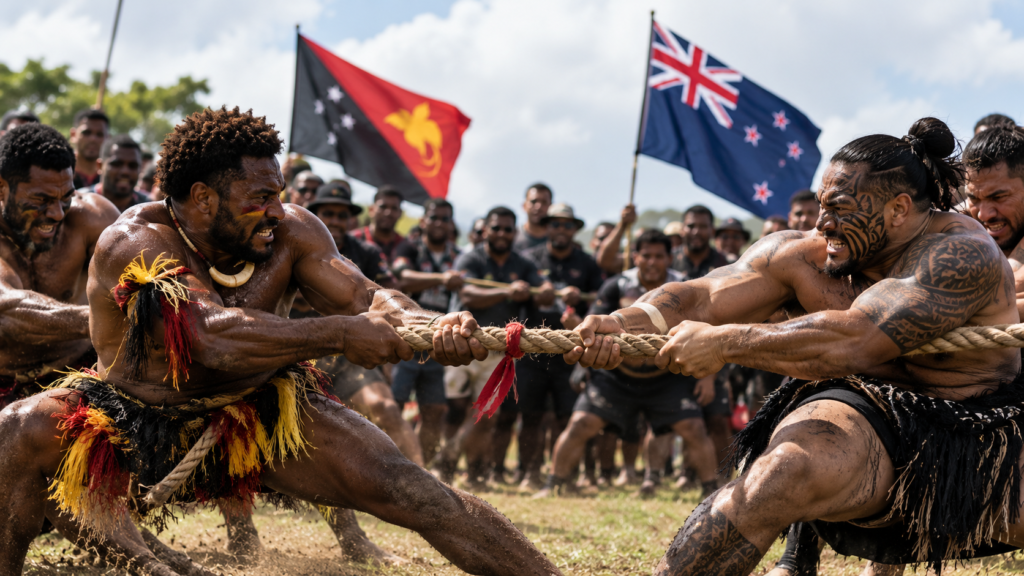
Professional rugby has spent years trying to expand its audience, attract new investment and establish itself in emerging markets. Yet here is a franchise bringing the sport into one of its most passionate heartlands, being challenged over a name already shared, in various forms, across the sporting world.
Australia has its Blues. New Zealand has its Blues. Sporting names have never been particularly exclusive territory.
Still, commercial rights exist for a reason, and New Zealand Rugby is entitled to defend what it believes belongs to its organisation.
The more difficult question is whether defending a brand and protecting the broader interests of the sport are always the same thing.
For PNG supporters, the immediate outcome is straightforward. The Chiefs name survives another day. The jersey launch goes ahead. The road to 2028 continues.
But the argument is far from finished.
And somewhere beneath the legal submissions, commercial interests and competing interpretations of trademark law lies a question that deserves a wider conversation.
At what point does protecting a sporting brand begin to look like standing in the way of another sporting dream?
Perhaps New Zealand Rugby is simply defending a valuable commercial identity.
Perhaps the PNG Chiefs should have chosen something entirely different.
Or perhaps two teams, playing two different sports in two different countries, can manage to share a word without civilisation collapsing.
The courts may eventually decide who has the stronger legal claim.
The supporters, meanwhile, will decide what the name is actually worth.
What do you think? Is New Zealand Rugby right to protect the Chiefs name, or has this dispute gone too far?